
Hourly IT Consulting Rates: Benchmarks for Service, Region & Experience

The short answer: hourly IT consulting rates range from $30 for a junior freelancer to over $300 for a specialized firm. That range is too wide to be useful. The actual cost is a function of experience, engagement model, and the specific technology stack involved.
A Data-Driven Look at IT Consulting Rates
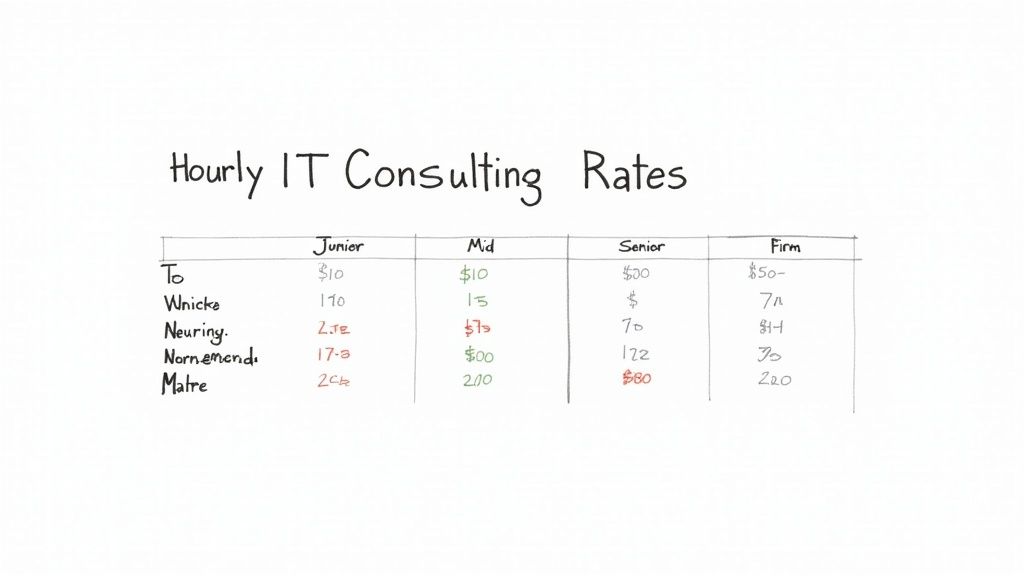
Budgeting for IT consulting often feels like asking for a number and getting the classic “it depends.” While technically correct, this response is unhelpful for building a business case.
These rates are not random; they fall into predictable ranges driven by clear economic factors. Understanding these benchmarks is the first step in shifting from “how much does it cost?” to “what is the total cost of the outcome we are buying?”
The most significant factor is the engagement model. An independent contractor has lower overhead than a consulting firm, and their rate reflects this. The same principle applies to experience—a senior architect with 15 years in distributed systems commands a higher rate than a junior developer executing pre-defined tasks.
This is a summary of current market rates.
Quick Guide to Average Hourly IT Consulting Rates
| Consultant Type | Experience Level | Typical Hourly Rate Range |
|---|---|---|
| Independent Freelancer | Junior (0-3 Years) | $30 – $47 |
| Independent Freelancer | Mid-Level (3-8 Years) | $80 – $150 |
| Independent Freelancer | Senior (8+ Years) | $100 – $200+ |
| Consulting Firm | Team-Based (Blended) | $150 – $300+ |
These figures provide a baseline for 2025 and highlight a fundamental decision.
Core Benchmarks for Hourly Rates
This data presents a key decision for your business:
- Independent Consultants: Offer a lower hourly rate and direct access to a specific expert. This model is effective for projects with a clearly defined scope and strong internal project management.
- Consulting Firms: Provide a team, integrated project management, and a broader knowledge base. The higher rate covers overhead and acts as a form of insurance for complex, high-risk projects.
The calculation is not about the hourly rate; it’s about the total cost to achieve the correct outcome. A senior consultant at $180/hour who solves a problem in 10 hours is more cost-effective than a junior at $50/hour who takes 40 hours to reach the same—or a suboptimal—solution.
Beyond the Basic Rate
These numbers are a starting point. Skill complexity is a major cost driver. For instance, a legacy system modernization project requires a specific combination of legacy technology knowledge and modern migration strategies.
Our guide on application modernization strategies details how such niche skills influence project costs and outcomes. The following sections will break down how geography, service type, and different pricing models further affect the final invoice amount.
How Geography Shapes IT Consulting Costs
The rate paid for an IT consultant is determined not just by skill, but also by location. Geography is a primary driver of hourly rates, often creating a price variance of 300% or more for equivalent technical talent.
This is a direct reflection of local economies, including cost of living, the maturity of the local tech market, and the concentration of specific skills. A senior cloud architect in San Francisco operates under different economic pressures than an equally skilled peer in Warsaw. Ignoring these regional differences means leaving significant budget on the table.
Understanding this landscape is the first step toward strategic sourcing. It allows for informed decisions about when the convenience of a local, high-cost consultant is justified versus when leveraging a global talent pool is more prudent.
North America & Western Europe: The High-Cost Regions
The most expensive IT talent is concentrated in North America and Western Europe. These regions contain major tech hubs, high costs of living, and intense competition for certified professionals, all of which drive up hourly rates.
While these regions offer a deep talent pool and convenient time-zone alignment, the cost is substantial. A common incorrect assumption is that higher cost correlates directly with higher quality. A consultant billing $250/hour in New York City is not inherently more skilled than one charging $90/hour in Lisbon; their rates reflect their local economies.
Eastern Europe & Asia: Cost-Effective Alternatives
Companies have long sourced cost-effective development from Eastern Europe and Asia, and the same trend applies to consulting. These regions possess highly skilled, often specialized technical talent at a fraction of Western prices. This is not about finding “cheap labor,” but accessing strong technical education systems and lower operational overhead.
Data indicates that North America and Western Europe consistently have the highest IT consulting rates. In the United States, 2024 rates can range from $45 to over $300 per hour. In contrast, hubs in Eastern Europe and Asia typically range from $25 to $75 per hour. You can find more details on these regional differences to see the potential for strategic outsourcing.
Equating premium rates with premium outcomes is a frequent mistake. The objective is to find value—a combination of skill, communication, and cost—not simply a high price. A project’s success is more correlated with a consultant’s specific expertise and fit than their location.
A Comparative Look at Regional Rates
To illustrate, here are the typical hourly rate ranges across key global markets for mid-to-senior level consultants.
| Region | Typical Hourly Rate Range (USD) | Key Economic Drivers |
|---|---|---|
| North America (USA/Canada) | $120 – $300+ | High cost of living, mature tech hubs, intense talent competition. |
| Western Europe (UK/Germany) | $90 – $250 | Strong economies, high demand for GDPR/compliance experts, large talent pools. |
| Eastern Europe (Poland/Ukraine) | $40 – $95 | Strong technical education, lower cost of living, growing tech ecosystems. |
| Asia (India/Vietnam) | $25 – $75 | Massive talent pools, heavy government investment in tech, cost-competitive. |
These numbers outline strategic options. For a large team on a well-defined development task, sourcing from Asia or Eastern Europe can significantly reduce the budget. For a strategic role requiring deep industry knowledge and constant on-site collaboration, a higher-priced local consultant might deliver better total value despite the higher hourly rate. The correct choice depends on the project’s specific requirements.
Analyzing Rates by Service and Specialization
There is no single “IT consultant” hourly rate. A generalist handling basic network support operates in a different cost category than a specialist architecting a multi-cloud Kubernetes environment. The required skill is the largest cost driver after the consultant’s location.
This price disparity is a function of skill rarity, certification costs, and the business impact of the work. Understanding these drivers is essential for accurate budgeting.
As previously noted, geography sets a baseline. The chart below shows how location can influence costs.
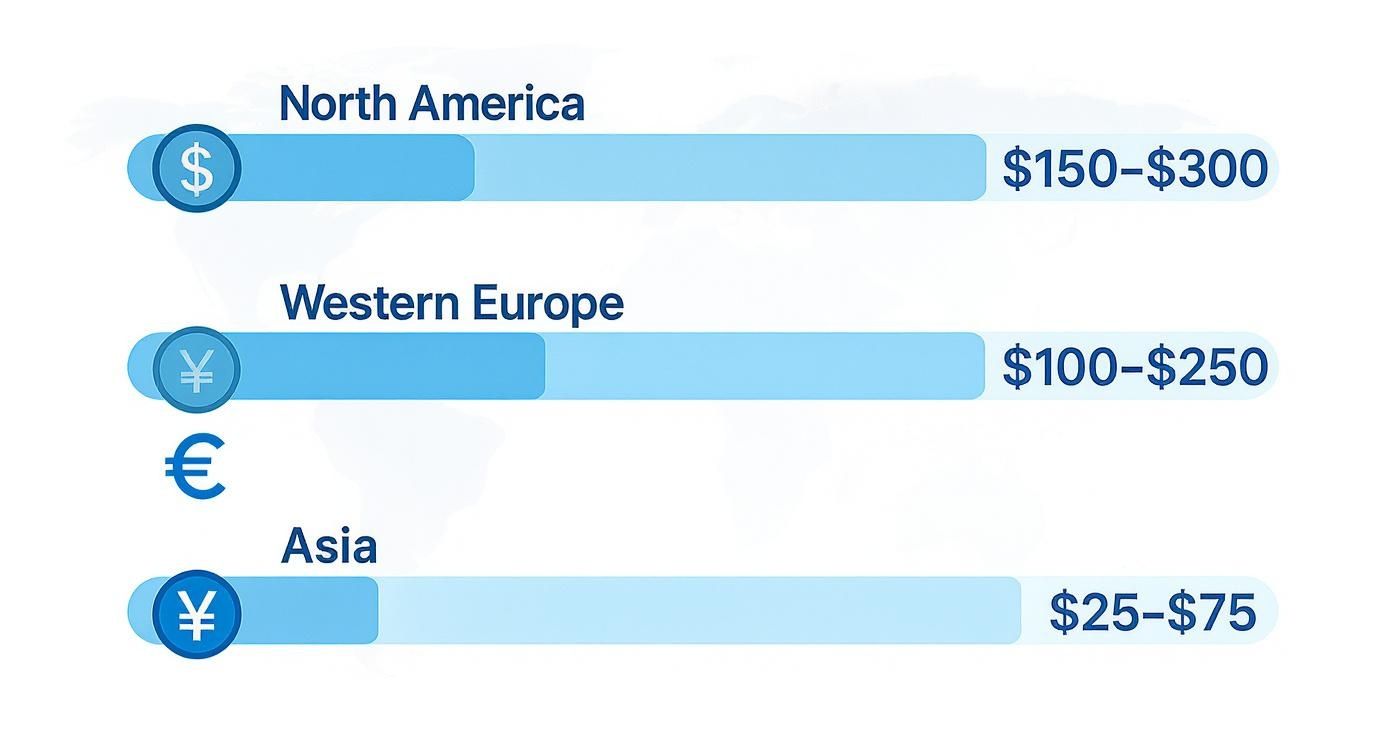
This data shows that acquiring talent in North America can be up to 4x more expensive than in parts of Asia for similar work, demonstrating how local economics impact budgeting.
High-Risk Fields Command Premium Rates
Certain IT roles consistently have the highest hourly rates. These are fields where a single error can result in significant financial or security consequences, and the pool of qualified professionals is small.
-
Cybersecurity Consulting: An experienced cybersecurity professional, particularly one specializing in incident response or penetration testing, can bill $250 to $450+ per hour. The rate is high because the alternative—a data breach, with an average cost of $4.45 million in 2023—is higher. You are paying for risk mitigation.
-
AI/ML Development: Specialists in artificial intelligence and machine learning are in extremely high demand. Senior AI/ML consultants often command rates from $200 to $400 per hour, driven by high demand and a limited supply of professionals with experience deploying production-level models.
The consultant managing your SAP S/4HANA migration bills at a premium because a failed ERP implementation can halt company operations. The high rate reflects the immense risk they are mitigating.
IT Consulting Rates by Specialization
Cloud architecture and Enterprise Resource Planning (ERP) systems are the operational backbones of most modern companies. Consultants in these areas require deep, platform-specific expertise. A consultant with an AWS Certified Solutions Architect - Professional certification has invested significant time and resources to validate their skills.
The table below outlines expected rates for common high-skill consulting services.
| IT Specialization | Typical Hourly Rate Range (US Market) | Key Cost Drivers |
|---|---|---|
| Cloud Architecture (AWS, Azure) | $175 – $325 | High certification costs, scarcity of multi-cloud experts, direct impact on operational costs and scalability. |
| ERP Implementation (SAP, Oracle) | $180 – $350 | Extreme complexity, high risk of business disruption, platform-specific knowledge that takes years to acquire. |
| Data Engineering & Analytics | $150 – $275 | Demand for specialists in platforms like Snowflake and Databricks, critical role in business intelligence. |
| General IT Support & Strategy | $100 – $200 | Broader talent pool, lower risk profile, less specialized technical requirements compared to other fields. |
The data is clear: the more complex and business-critical the system, the higher the cost for an expert who can manage it successfully.
Why a Generalist Is Not a Specialist
Hiring a general IT consultant for a specialized task to save on hourly rates is a common but costly error.
A generalist at $125/hour might spend 80 hours on a system that a $250/hour specialist could have designed and deployed correctly in 20 hours. This results in a higher total bill, a delayed project, and a poorly architected system that will incur future costs. Paying a premium for a specialist is an investment in achieving the correct outcome on the first attempt.
Ditching the Billable Hour: A Look at Smarter Pricing Models
Paying an IT consultant by the hour is common but often suboptimal. It’s easy to track but creates a potential misalignment of incentives: the client wants the job done quickly, while the consultant’s revenue is tied to hours billed. The billable hour is suitable for unpredictable support but is often the wrong model for projects with defined outcomes.
Alternative pricing models exist to align the consultant’s success with the client’s. The right model depends on the project’s clarity and predictability.
Project-Based Fixed Fee Billing
A project-based or fixed-fee model involves one price for a specific, well-defined scope of work. It is equivalent to buying a finished product, not the labor. This is the preferred model when deliverables, timelines, and requirements can be specified with high certainty upfront.
- When to Use It: Ideal for a contained database migration, a website build with a locked feature set, or implementing a known software package.
- Pros: Provides absolute cost certainty, simplifying budgeting. It incentivizes the consultant to be efficient, as their profit margin is tied to completion, not duration.
- Cons: The primary risk is scope creep. Any new requirement necessitates renegotiation or change orders, which can strain the relationship. This model lacks flexibility for projects requiring exploration or adaptation.
The Retainer Model
A retainer secures ongoing access to an expert for a flat monthly fee, covering a block of hours or general availability for strategic advice, maintenance, and smaller tasks.
This model shifts the consultant from a temporary project resource to an integrated team member. It fosters a long-term partnership where the consultant develops deep institutional knowledge of your systems and business challenges.
This is an area for strategic use of global talent. For example, India offers competitive retainer rates from $25 to $80 per hour. For teams requiring closer time-zone alignment, Canada offers a balance of cost and quality, with rates typically between $80 and $150. This global spectrum allows you to find a long-term partner that fits your budget. Discover more insights about IT consulting rates globally.
Value-Based Pricing
Value-based pricing is a sophisticated model where the consultant’s fee is tied directly to the business value they generate. This could be a percentage of cost savings, a share of new revenue, or a bonus for hitting a key performance indicator (KPI).
- When to Use It: For high-impact projects with a clear, measurable ROI, such as a cloud cost optimization initiative or the development of a new revenue-driving feature.
- Pros: Creates perfect alignment. Both parties are focused on the same business outcome, not just completing tasks.
- Cons: This model’s success depends on the ability to accurately measure and attribute value, which is often difficult. It requires a high degree of trust and transparency to agree on success metrics. Many such arrangements fail because the ROI calculation is either overly optimistic or poorly defined.
Identifying Hidden Costs That Inflate Your Budget
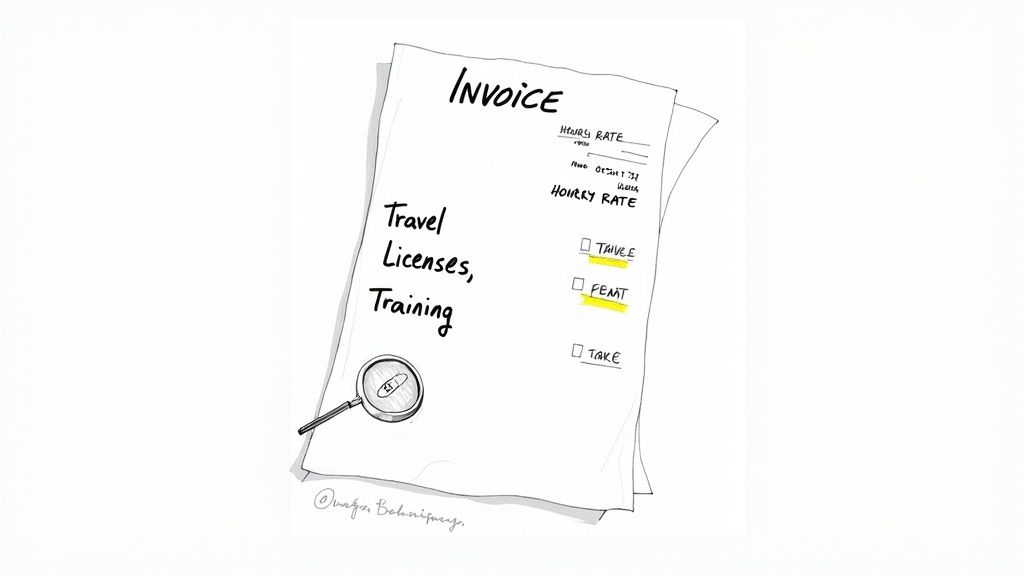
The quoted hourly rate is just the starting point. Assuming this number is the final cost is a common and expensive error. A consultant billing at $150/hour can easily approach a blended rate of $200/hour or more once all line items are included on the final invoice.
This is not always intentional; vendors are not incentivized to highlight costs outside their primary rate. A skeptical approach during procurement is the best defense against budget overruns. Treat every proposal as a starting point for negotiation.
Uncovering Common Pass-Through Expenses
Many consulting agreements include clauses allowing vendors to pass operational costs directly to you. While often legitimate, these expenses must be defined and capped.
- Travel and Expenses (T&E): The most common add-on for on-site work. Flights, hotels, and meals are typically covered, but costs can escalate without clear rules. Insist on a “not-to-exceed” daily cap or require pre-approval for expenses over a specified amount.
- Software and Licensing: Consultants often use specialized toolkits. Clarify who bears the cost. A $5,000 annual license for an analytics platform is an unwelcome surprise if you assumed it was part of their standard overhead.
- Administrative Overhead: Some firms add a percentage-based fee—typically 5-10%—to each invoice to cover project management and back-office support. This effectively inflates every billable hour and should be negotiated upfront.
The Problem of “On-The-Job Training”
This is a more subtle but significant hidden cost. A firm may feature a senior partner in the sales process, but a junior consultant performs most of the work, learning on your project and at your expense.
You are paying a premium rate for expertise, not for a consultant’s professional development. If a junior resource is performing tasks, they should be billed at a junior rate. Insist on rate cards that specify different hourly IT consulting rates for each seniority level.
To prevent this, the contract should name the specific individuals assigned to the project. Any substitutions should require written approval, with rate adjustments reflecting the new person’s experience level. This ensures you receive the expertise you are paying for.
Due Diligence Questions to Ask Vendors
Before signing a contract, obtain written answers to these questions and ensure they are incorporated into the final agreement.
- Does your rate include all project management and administrative overhead? This forces disclosure of any hidden percentage-based fees.
- What specific software, hardware, or cloud service costs will be passed through to us? Request a detailed list with estimated prices.
- What is your policy on travel and expenses? Obtain their official T&E policy and negotiate reasonable caps before work begins.
- Who are the specific individuals assigned to this project, and what are their individual rates? This prevents the “bait-and-switch” where a senior partner sells the project but junior staff execute it.
Clarifying these details is as critical to your project budget as implementing effective cloud cost optimization strategies is for your infrastructure spend. The goal is total transparency. A reputable partner will have no issue providing this information.
A Practical Framework for Selecting the Right IT Consultant
Choosing an IT consultant based on the lowest hourly rate is a common mistake. A low bid is not a sign of value; it is often a red flag for inexperience or a misunderstanding of project complexity. This approach frequently leads to delays, rework, and a higher total cost.
The objective is not to find the cheapest partner but the one who delivers the most value. This means finding the optimal blend of expertise, project fit, and total cost of ownership. This requires a structured approach that goes beyond the proposal to validate a consultant’s ability to deliver.
Align Pricing Models with Project Goals
First, ensure the billing structure fits the project’s reality. As discussed, a fixed-fee model is suitable for projects with a well-defined, static scope. An hourly rate is appropriate for exploratory work requiring flexibility.
Do not let a vendor push you into a model that primarily benefits them.
- For Defined Projects: If the scope is clear, request a fixed-fee proposal. This incentivizes efficiency and protects your budget.
- For Exploratory Projects: An hourly model is acceptable, but with guardrails. Insist on a detailed rate card breaking down costs by seniority level. You should not pay a senior rate for routine tasks.
Validate Expertise Beyond the Resume
A resume is a set of claims; a track record is evidence. Due diligence must focus on tangible proof that a consultant has solved a similar problem for a similar company. Past performance is the most reliable predictor of future success.
A vendor’s case study is a marketing document. A reference call is where you get the unvarnished truth. Ask pointed questions about how the consultant handled scope changes, communicated delays, and integrated with the internal team.
Be specific in reference checks. Instead of asking, “Were you happy with them?” ask, “What was the biggest unexpected challenge during the project, and how did the consultant handle it?” This question reveals their problem-solving skills and transparency.
Our complete vendor due diligence checklist provides a structured guide for these critical conversations.
Conduct a Paid Discovery Phase
For any significant project, a small, paid discovery phase is non-negotiable. It is a low-risk “test drive” before committing to a larger contract. A typical discovery phase lasts one to two weeks and produces a concrete deliverable, such as a technical roadmap or a proof-of-concept.
This trial period accomplishes three critical objectives:
- Assess Technical Competence: You observe their skills applied directly to your problem.
- Evaluate Cultural Fit: You learn how they communicate, collaborate, and handle feedback.
- Validate Project Scope: They gain a deeper understanding of your requirements, leading to a more accurate final proposal and Statement of Work (SOW).
If a potential partner resists a paid discovery, it is a significant red flag. A confident consultant will welcome the opportunity to prove their value before seeking a larger commitment.
Your Questions About IT Consulting Rates, Answered
Here are answers to the most common remaining questions to help you prepare for vendor negotiations.
Are Lower Hourly IT Consulting Rates Always a Red Flag?
Not always, but they require deeper scrutiny. A consultant in a lower-cost region might quote $40/hour for work a US-based expert charges $150/hour for. The price difference itself is not a red flag; it is a signal to verify all claims.
A low rate could indicate a cost-effective find due to geographic advantages, or it could mean you are hiring someone who will learn on your project. Due diligence is the only way to distinguish between the two.
- Get Technical: Have your senior engineers conduct a rigorous technical screening.
- Show Me the Code: For developers, request code samples from non-sensitive projects. Clean, well-documented code is a strong positive indicator.
- Talk to Past Clients: Go beyond simple reference checks. Discuss communication, deadlines, and how they handled unforeseen problems.
A low rate is only valuable if the quality meets requirements. Otherwise, it is an expensive mistake.
How Much Should I Budget on Top of the Hourly Rate?
Plan for a 15-25% contingency fund on top of the total estimated cost. This is not “extra” money; it is a realistic buffer for predictable costs that are often omitted from initial proposals.
This fund acts as a shock absorber for inevitable issues like unexpected travel, unaccounted-for software licenses, or minor scope adjustments. For long, complex projects with many unknowns, a larger buffer may be appropriate. Clarify these potential extra costs in the contract before signing.
A project that comes in perfectly “on budget” without a contingency was likely padded from the start. A 15% buffer isn’t a slush fund; it’s the signature of a realistic plan.
When Does a Project-Based Fee Make More Sense?
A fixed, project-based fee is best when the scope is clear and static, such as migrating a specific database or building an application with a fixed feature set. It provides cost certainty.
However, if a project is exploratory, involving R&D with an evolving scope, an hourly rate is superior due to its flexibility. Forcing a fixed fee onto an undefined project is a recipe for conflict over what is “in scope” versus what constitutes a change order.
Making the right vendor decision requires more than just rate cards. Modernization Intel provides the unvarnished truth about implementation partners—their real costs, common failure points, and true specializations—so you can choose a partner based on performance, not promises. Get your vendor shortlist at https://softwaremodernizationservices.com.
Need help with your modernization project?
Get matched with vetted specialists who can help you modernize your APIs, migrate to Kubernetes, or transform legacy systems.
Browse Services